World Tennis Number (WTN)
WTN Algorithm Update - August 2026
World Tennis Number (WTN) Algorithm Enhancements 2026
WTN continues to evolve to provide a more accurate, fair and meaningful rating system for tennis players worldwide.
Based on feedback from players, coaches and national associations, we are introducing enhancements to the algorithm on Wednesday 12th August 2026 to improve rating accuracy, reflect real match performance, and support player development at all levels of the game.
A more efficient and sustainable rating system
As global participation in WTN grows, the algorithm will now operate using a rolling three-year rating window.
This means:
- Ratings are based on recent match results
- Older results gradually drop out of the calculation
- The system remains efficient and scalable worldwide
- This ensures ratings stay current and accurately reflect a player’s playing level.
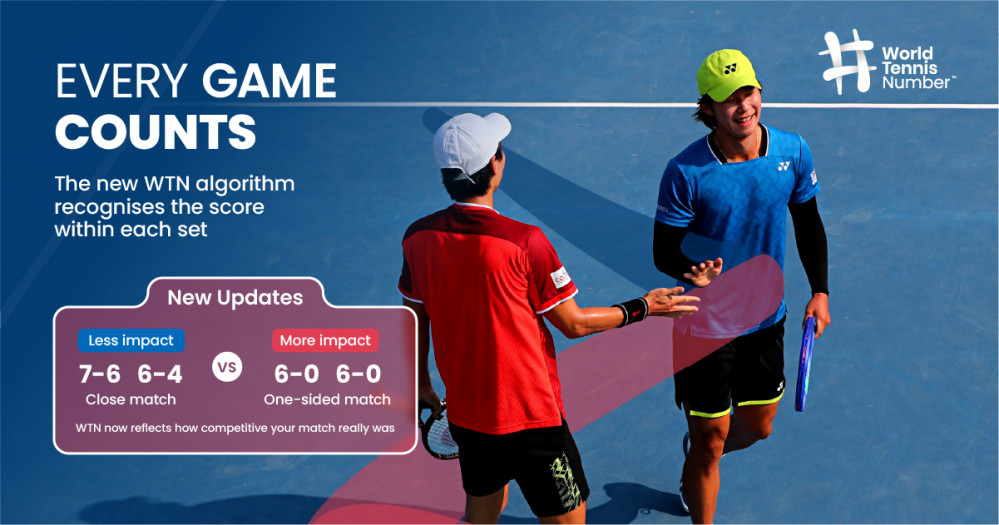
Every game now counts
The updated algorithm now includes the use of game-level scores, rather than only set-level results.
Previously, a 6-0 set and a 6-4 set played within the Game zONe had the same impact on ratings. Now:
- A 6-0 set produces a larger rating movement
- A 6-4 or 7-5 set produces a smaller movement
- Close matches are more accurately reflected
- Rating changes are also influenced by the expected outcome of a match, meaning performance is measured against what the algorithm predicts.
- This encourages players to compete for every game and rewards strong performances—even in close losses.
Supporting player development
To better reflect how players can change physically in terms of strength and power, especially juniors, a player development adjustment has been introduced.
Ratings may be gently adjusted based on:
- Age
- Time since last match
- Typical development patterns
This helps ensure ratings reflect a player’s likely current level, particularly during key development stages. Ratings will now better reflect natural player development over time - particularly for juniors - helping improve alignment with adult levels.
Ratings reflect current playing level
A rating decay mechanism has been introduced to account for players returning after time away from competition.
- Ratings gradually adjust after extended inactivity
- Changes are controlled and incremental
- Ratings remain relevant to current performance
This helps returning players compete at appropriate levels and improves fairness across the system.
Continuing to improve WTN
These enhancements ensure the World Tennis Number system continues to:
- Reflect real match performance
- Encourage competitive effort and resilience
- Support player development
- Create fair and meaningful competition
WTN will continue to evolve based on feedback from the global tennis community.
WTN Algorithm Changes FAQS
Why is the World Tennis Number (WTN) algorithm changing?
The enhancements improve how ratings reflect match performance and respond to feedback from players, coaches and National Associations. The changes are designed to make ratings fairer, more reflective of current playing level, and better aligned with player development.
Will my rating change because of these updates?
Algorithm enhancements could affect all players, as we are making fundamental changes to how ratings are calculated. Our analysis indicates that players who compete regularly are generally less affected in terms of their position relative to other players but their rating may see an improvement.
Overall, will most players see their ratings go up or down?
The primary outcome is improved rating accuracy, with ratings better reflecting current performance, player development and relative position among peers.
Will these changes affect competitions that use WTN?
Competitions will continue to operate as normal and if they use WTN, they will do based on the information available prior to the entry deadline. The primary change is that ratings should provide a more accurate reflection of current playing level and competitive performance.
Will the WTN algorithm change again in the future?
Yes. WTN will continue to evolve as participation grows globally and feedback is received from players, coaches, National Associations and competition organisers.
How is the doubles algorithm affected?
The doubles algorithm will also have the same set of changes applied to it. In addition, the doubles algorithm will also stop considering the rating of your partner in the calculation to better reflect your performance against your peers.
Will younger players see changes to their ratings over time?
Yes. The system includes a small adjustment to reflect natural player development, particularly among junior players. This helps ensure ratings remain aligned with improving physical and technical ability.
What does "every game counts" mean?
While set outcomes remain the dominant component of the rating system, game-level results will also be taken into account. This means that closer sets, such as 6-4 or 7-5, are treated differently from more one-sided sets such as 6-0, providing a more accurate reflection of match performance following feedback from players and coaches.
By recognising performance within sets, the system better reflects relative playing strength.
I won my match but my WTN didn't improve. How is that possible?
WTN reflects not just whether you win, but how you perform compared to expectations. If you are expected to win comfortably but the match is closer than the algorithm’s expectation, your rating may stay the same or get worse. This helps ensure ratings accurately reflect performance levels.
Is there a benefit to winning by a larger score?
Generally, more decisive wins can result in greater positive impact, especially when they exceed expectations. However, the system is designed to recognise overall performance.
Is there a limit to how much a big win can improve my rating?
Rating changes continue to consider the rating of your opponent as as a key part in your performance. For example, a dominant win against a stronger opponent is likely to have a greater impact than a dominant win against a weaker opponent.
Do different match formats affect ratings differently?
Yes. All recognised match formats are included in the WTN calculation. The system adjusts weights for different format structures to ensure ratings remain fair and consistent across competition types. Therefore, longer form sets have more weighting than shorter form sets.
How are tiebreaks treated in the rating?
Match tiebreaks are included as part of the overall match result. However, they have a lower weight to a full set because they are played over a shorter format.
What is the three-year rating window?
The algorithm now focuses primarily on match results from the past three years, helping ensure ratings reflect recent performance and current playing level.
Will older match results disappear?
Older results will continue to appear in a player's match history. However, once they fall outside the three-year rating window, they will no longer influence rating calculations.
Will my rating drop suddenly when older matches fall outside the three-year window?
No. The transition is gradual. Older matches naturally reduce in influence over time, so rating changes are typically smooth rather than sudden.
Can playing more matches remove older results faster?
No. The three-year window is based on time, not match volume. Playing more matches will not accelerate the removal of older results, but it will provide more recent results that help inform your current rating better.
What happens if I don't play many matches?
Ratings are most accurate when based on recent activity. If you play less frequently, your rating becomes less reliable and your confidence level will decrease over time.
Why are ratings adjusted for inactive players?
If a player has not competed for a long period of time, their rating may no longer reflect their current level. Gradual adjustments help maintain fair competition and improve the accuracy of ratings.
Will my rating decrease if I stop playing for a while?
If you do not compete for over a year, a small and gradual adjustment may be applied to reflect the impact of inactivity.
What happens if I return to tennis after a long break?
Your rating may have adjusted slightly during your period of inactivity, but it will quickly become more representative of your current level once you resume competing regularly.
What happens if I play someone outside my Game zONe?
Matches against players both inside and outside your Game zONe count toward your rating. The GameZone is a representation of where level-based play can happen. If you win against someone rated better than your GamezONe, you will improve more than if you win against someone within or worse than your GameZone.
Will playing opponents far above or below my level harm my rating?
Not necessarily. The system considers the expected outcome of the match. Playing stronger or weaker opponents will not negatively impact your rating if your performance aligns with expectations.
What happens if a match is not completed, for example due to retirement?
The algorithm considers available score data while maintaining fairness and integrity within the rating calculation.
Is there any advantage to stopping a match early to protect my rating?
No. The system is designed to discourage this behaviour. Completing matches and competing for every game provides the most accurate reflection of performance.
World Tennis Number General Info
ITF WORLD TENNIS NUMBER (WTN)
The World Tennis Number - nationwide from September 2025.
While tournaments in New Zealand have used the WTN for seeding since 2023, the WTN is now used in interclub.
- A global scale for everyone, regardless of age, gender or ability
- A modern online system that calculates a player’s number on a weekly basis
- A separate number for singles and for doubles
- Find opponents that are evenly matched to you, wherever you are in the world
- Be part of the largest global tennis community
- Free to use
What Is The WTN?
The WTN is a worldwide rating system for tennis players.
Powered by the International Tennis Federation (ITF), the WTN is calculated by a powerful algorithm that is informed by data from over 80 million match records from around the world.
HOW THE WTN WORKS
Players are assigned a WTN number between 40 and 1. Beginners start closer to 40 and professionals are nearer to 1.
The algorithm calculates your number on a weekly basis. Getting out on court is the key to seeing yours change.
More Info: Calculations and Confidence
For every match the WTN algorithm analyses each players' pre-match rating and predicts a winner. Each player’s WTN number will then change based on the score and how it compares to the prediction.
The more matches a person plays, the more effective the algorithm becomes, meaning players can feel confident that their number is accurate.
With numbers updated weekly, the WTN is continuously monitored and tested to ensure rankings are as accurate as possible, leading to more competitive matches.
NOTE: The confidence level will not be taken into consideration across Summer Interclub 2025/2026.
The Confidence Level is a measure of how accurate your rating is.
A Confidence Level of 70% and above indicates that the WTN is verified. There will be a tick beside the rating on the player profile (on the World Tennis Number website).
Initial WTN ratings are at a lower “Confidence Level” until more match results are recorded.
The Confidence Level can have a significant impact on a player’s rating. Faced with the same set of results, two players with the same rating, but with different Confidence Levels, will experience different rating updates. The player with a lower Confidence Level will see his/her rating fluctuate more.
As a guide, a verified WTN (70% and above) can be achieved by completing five or more matches in a consecutive five week period. There are instances where slightly more matches are required, such as if a player has had an extended time away from playing.
A player's confidence level falls with inactivity and after a year will be down to 10%.
It is important to consider that the WTN takes more into consideration when calculating a player’s WTN, therefore it is possible two players who were the same S or D grade, may have different WTNs.
Factors like:
- Confidence Level
- Match Scores
- Age and Gender
With all this in mind, we have randomly selected some active MatchHub players, and have displayed their WTN below.
Female Player #1 (Northland) - MatchHub Ranking = S6 - WTN = 26.5
Female Player #2 (Central) - MatchHub Ranking = S4 - WTN = 21.5
Female Player #3 (Central) - MatchHub Ranking = S6 - WTN = 27.0
Female Player #4 (Central) - MatchHub Ranking = S6 - WTN = 28.2
Female Player #5 (Central) - MatchHub Ranking = S8 - WTN = 28.7
Male Player #1 (Canterbury) - MatchHub Ranking = S4 - WTN =19.9
Male Player #2 (Auckland) - MatchHub ranking = S6 - WTN =24.4
Male Player #3 (Canterbury) - MatchHub Ranking = S8 - WTN = 28.1
Male Player #4 (Canterbury) - MatchHub Ranking = S8 - WTN = 28.5
Male Player #5 (Eastern) - MatchHub Ranking = S10 - WTN = 31.3
Yes, match results are analysed at set level, meaning the algorithm takes into account each individual set as its own result.
The WTN algorithm compares its score prediction with the actual score to determine what a player’s specific rating should be.
A retirement where a set has been completed does count toward a player’s WTN.
General WTN FAQS
If you have a question about the World Tennis Number that is not currently in the FAQs below, please email info@tennis.kiwi and we will look into adding it to the list.
Around 95% of NZ players have a WTN.
A WTN will have been generated for interclub players, as long as:
1. You have a date of birth associated with your MatchPoint account (and are nine years or older).
2. You have played a match in a MatchPoint-run competition.
Head to the MatchPoint WTN player list and type in your name.
If you do see yourself, you will be able to see your singles and doubles WTN. You will be able to create a WTN account to be able to access the extra WTN website features.
If you need a hand with any of this, check out the guide here.
Once we have your date of birth it may take a week or two before your WTN will be live.
Six years of interclub results were uploaded and run through the WTN algorithm to calculate initial WTNs for all players.
For a result to be sent to the ITF for WTN calculation, all participants must have a WTN. This could mean you have played with or against some opponents who have not yet got a WTN (likely from missing a date of birth in the system).
As more and more players receive a WTN, this will allow your match history to be submitted and you will notice more of your matches appearing on the WTN platform.
We will leave MatchHub (tennis.org.nz) available to view historic matches. We will display clear messaging that pushes people to the new platforms to see/use their current results.
MatchHub's S and D gradings were maintained until the end of 2025.
During time periods in which a player does not compete, their WTN rating remains unchanged, but their confidence level decreases. This is the way the algorithm captures the increased uncertainty around a player’s rating.
Players who do not take part in competition for a significant period, caused by injury, off-court issues or other factors, will have a lower confidence level when they return to play.
The algorithm will react more strongly to the results as it tries to calibrate the player’s rating after a long absence of data.
It’s a tool for college coaches to use to evaluate prospective student-athletes worldwide.
Along with many of the world’s National Tennis Federations of note, the Intercollegiate Tennis Association in the USA (responsible for the administration of college tennis,) have announced the World Tennis Number as their official rating.
This will have flow-on effects for NZ players either currently involved in the college system or seeking college scholarships and highlights the importance of aligning with the global system that the World Tennis Number provides.
Click here for more info on this partnership here.
Yes. The ITF World Tennis number is a global system and as such any player who has competed abroad in a nation that also supports the ITF World Tennis Number will have one number which reflects all matches played at home and abroad.
Statistics to track your game, follow your friend’s and opponent’s progress, including viewing win/loss ratios and head-to-head comparisons.
Check it out here
The Game zONe identifies a range of potential opponents whose Numbers are close to yours on the scale.
Game zONe will find evenly-matched opponents wherever you are, to ensure the best possible experience on court
The industry-leading algorithm analyses player performance data and millions of match results.
For example - if your singles WTN is as shown here: 28.2, the WTN Game zONe predicts in order for your to have a competitive game, you’ll need to play someone between 31.2, and 25.2.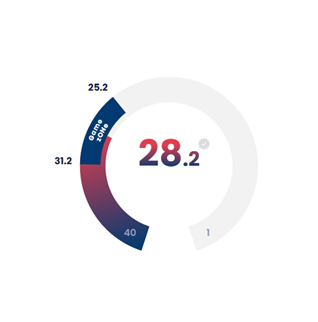
Player numbers have been based on historical match data from the last six years, ensuring each person has an accurate rating when the system launches.
Because each number is determined through a precise, objective and advanced mathematical formula, it won’t be possible to challenge or appeal the outcome.
The ITF World Tennis Number’s match predictions are more detailed than a simple win or loss. The system calculates the likelihood of various results and adjusts player numbers accordingly.
This means that no matter the relative level of the two players, if someone performs better than expected based on the prediction, their ITF World Tennis Number can still improve.
If your WTN hasn’t changed in the last two weeks and you’ve played matches, please contact the organiser of those tournaments.
Click here to learn more about how your number is calculated.
Click here to reach out to the WTN team support team.
Our Partners